

 |
15 Apr 2026 | 15.16
|
15 Apr 2026 | 15.16





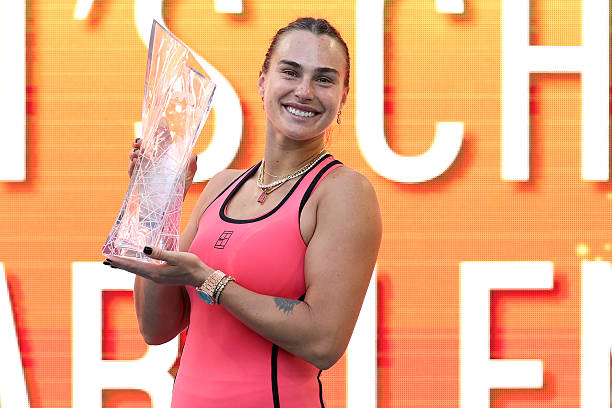
Aryna Sabalenka is going through one of the most dominant moments of her entire career. The Belarusian, current world number 1, has started the season with great authority, stringing together prestigious titles in Indian Wells and Miami. More mature, more stable, and with a confidence that seems unshakable, Sabalenka has turned her usual power into a much more complete version of herself.
But beyond her sports performance, what stands out the most in this phase is the harmony that she seems to have found between the player and the person. Her off-court life, much more settled, and deep work on emotional management have shaped a different champion. Aryna herself reflects this in the extensive interview given to Esquire, where she opens the door to her more human side.
The balance between competition and life
Far from hiding her contradictions, the world number one embraces them as an essential part of the process that has led her to the top. “On the court, I am aggressive, emotional, I need to be to bring out my best tennis. Off the court, I am completely different.” An evident contrast that she acknowledges and manages: “I am balancing these two personalities really well.”
She does not reject the past; on the contrary, she embraces it. “You hit as hard as you can, release all the tension, and then let it go when the racket is broken. Sorry, Wilson...,” she said ironically. But today, control has become part of her game: “I will always be myself, but there is a line beyond which you become a terrible person and you can't cross it,” she explained.
“I wanted to quit, but it made me stronger”
"In 2022, I couldn't serve. It's something I wouldn't wish on my worst enemy. You do something your whole life, and then suddenly, it just doesn't work anymore. You just want to give up,” she stated. And yet, it was precisely there where today's Sabalenka was built. “That period made me stronger than ever. Now I know that even without a serve, I can fight and try to win. When I serve, I think about the goal, about a few key points. When you are relaxed, a great serve comes out. If you force it, only tension appears.”
Learning from mistakes
Maturity, for Sabalenka, also involves learning from mistakes. Like after losing the final at Roland Garros 2025 to Coco Gauff: “At the press conference, I didn't know what I was saying. I was too nervous. Then I checked the stats, talked to my team, and changed my mind. I wrote to Coco to apologize.” Ultimately, tennis is just one element in her life. “During tournaments, I don't drink, but after a big win, I celebrate. It's important to find the balance. Cutting everything out in life is not healthy; you risk losing control.”
This news is an automatic translation. You can read the original news, Sabalenka: “Quise dejarlo, pero me hizo más fuerte”












-
 16 Apr 2026 | 11:00We analyze the Asics Solution Speed FF4 sneakers
 -
 16 Apr 2026 | 14:00This is how the historic prize money of Roland Garros 2026 is distributed
 -
 15 Apr 2026 | 16:00Jódar delights against Carabelli and keeps dreaming in Barcelona
 -
 16 Apr 2026 | 21:00Bruguera: "I see players with a lot of lack of ambition"
 -
 15 Apr 2026 | 19:00Montecarlo or Barcelona, it must be only one of the two for Alcaraz